 Michele Eccher
On this page
Define the work before requesting proposals
“We want more traffic” leaves the provider to decide which visitors to attract. Specify your priority product or service, the customers you want to reach, and what you want them to do on your site: buy, request a quote, or book an appointment. Include whatever is preventing you from making progress today.
For a specific problem, such as important pages disappearing from search after a platform change, ask for a diagnosis and a plan to fix it. If you already have a plan and people to carry it out, you may need someone to oversee the work. If you also lack writers and developers, the engagement must cover those roles or involve other professionals. For ongoing work, name the person in your business who can set priorities.
A sample brief you can adapt
Illustrative example: an industrial maintenance company
“Our English-language site has 35 pages. We want maintenance inquiries from plant managers in Ohio. Our sales team can assess which inquiries are relevant. A technical specialist can spend two hours a month on interviews, but we have no writer. Our outside developer can make updates once a month. We want to start with our four service pages without rebuilding the site. Please specify the analysis, writing, technical changes, and checks you would provide, along with the work you would need from our team.”
Replace those details with your own and send the same brief to two or three candidates. If you cannot quantify a problem, describe the symptoms and say what data you have. The provider's first questions should help fill in the gaps: which services take priority, what inquiries you already receive, and who can approve the copy.
SEO agency, consultant, or in-house team?
The company in our example has no writer and limited access to a developer. An agency that supplies both may reduce the coordination your company has to handle. A consultant may also fit if they have collaborators available or your company can fill those roles. The agency or consultant label does not tell you who will actually do the work.
If you also need a partner for advertising, creative work, and other channels, the guide to choosing a subscription-based marketing agency explains how to evaluate that working arrangement.
Review a similar project and meet the people doing the work
Ask each candidate to explain a project that involved a problem like yours. For an ecommerce site, that might mean managing categories and filters. For an industrial business, it might mean turning technical expertise into pages that help buyers evaluate a supplier. A similar problem can make a case study useful even when the industry differs.
Ask to see a page or deliverable and work through what changed: the starting point, the actions taken, the period measured, and the source of the results. Find out what the candidate did and which people on the client's team were needed. A rising traffic graph without that context tells you little about what the provider can do for your site.
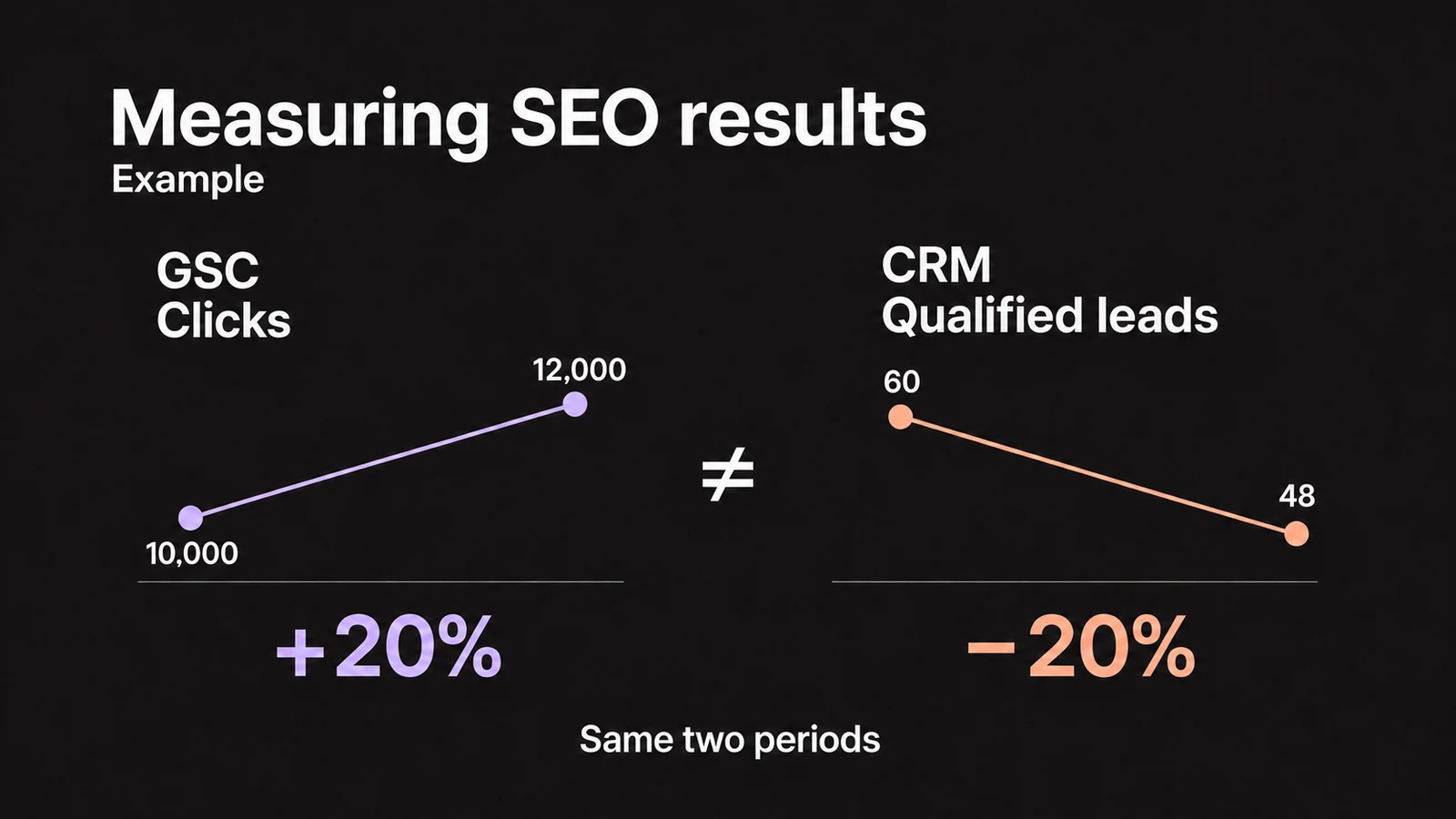
Qreativa's case studies cover two different situations: Beton Asfalti involved specialized content about road construction and maintenance, while Revée involved multilingual content for an ecommerce business. Visibility or traffic gains alone do not prove sales growth. That requires sales data connected to the work performed.
Arrange a conversation with the person who will manage your project. Ask them to explain a problem from the case study and how they decided what to tackle first. Record who will answer technical questions after you sign, which tasks will be delegated, and what happens if your main contact changes.
Google recommends checking references. If a past client is willing to speak with you, ask how the provider handled deliverables and delays, and how clearly they explained results. These checks are part of Google's advice on hiring an SEO.
Follow one change from analysis to publication
Ask each candidate how they would approach one of your service pages. You can also use an example from a completed project to discuss their process and responsibilities. The aim is to find out where advice ends and implementation begins.
Proposing the change
Whoever identifies the issue should show the affected page, explain why it needs work, and specify what to check afterward. “Improve SEO” does not identify a deliverable.
Production and approval
For content, ask who gathers the information and who writes. For technical changes, ask who prepares specifications and who develops them. Assign approval too: your technical specialist can check accuracy without having to write the entire page.
Publishing and checking
Agree on who publishes the change and who checks the page, links, and tracking. If your developer is available only once a month, the plan needs to account for that.
Reviewing the outcome
Agree on where to record the publication date, what happened afterward, and the next decision. Delivery dates and the time it takes to see search results are separate questions. Read more about how long SEO takes.
For a preliminary audit, Google recommends granting read-only access to Search Console. Once work starts, assign the permissions needed for the agreed tasks while keeping your accounts and domain under your company's control. Ask the provider to maintain a shared log of changes.
Example: what an incomplete SEO proposal leaves out
Suppose the industrial maintenance company receives this proposal: “Initial audit, optimization for 20 keywords, two pieces of content per month, and a monthly report.” This is an illustrative offer. It does not tell you whether anyone will write and publish the four service pages requested in the brief.
On a phone, scroll the table horizontally to read all columns.
| Proposal item | What to ask | A useful answer for this example |
|---|---|---|
| Initial audit | What will you review? What will we receive? | A technical review and an assessment of the four service pages, with documented issues, priorities, and the people needed to fix them. |
| 20 keywords | Which pages and customer needs do they relate to? | A map of relevant searches to the four pages, with rank tracking clearly separated from work to improve those pages. |
| Two pieces of content per month | Are these new articles, rewrites, or instructions for our team? | Rewrites of the four service pages, two per month, including an interview with the technical specialist, one revision round, and a named person responsible for publishing. |
| Monthly report | What data will we review, and what decisions will it support? | Completed changes, performance of the affected pages, and recorded inquiries, with the sales team assessing which inquiries are relevant. |
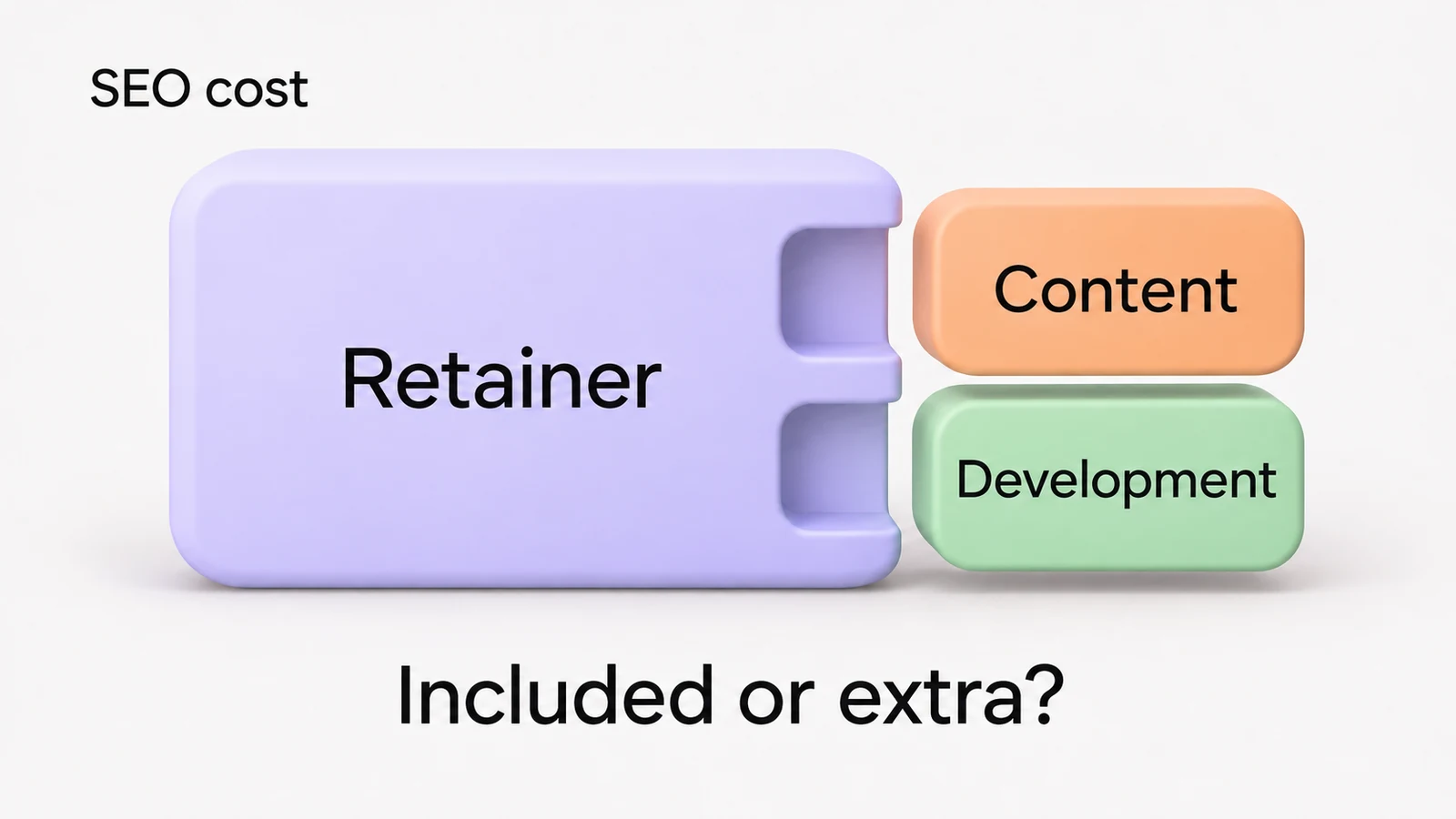
Have the provider add these answers to the revised proposal. If development is excluded, get an estimate and confirm your developer's availability before accepting the plan. To compare retainers, setup costs, and extras over the same period, use the calculation in the guide to how much SEO costs.
A sample report should distinguish completed work, traffic, and business results. The guide to measuring SEO results explains how to assess these together.
Evaluate ranking promises, link building, and AI search services
Google warns that no one can guarantee the top ranking and advises caution around claims of a special relationship with the search engine. A claim like that is a reason to rule out a candidate. Ask for commitments on deliverables, staff availability, checks, and explanations of the work.
If the proposal includes links, ask how they will be earned, what kinds of sites they will come from, and how you will approve the work. Google's spam policies prohibit buying links to manipulate rankings. A promise to deliver a set number of links each month without explaining the method leaves a risk you should resolve before hiring.
If the provider offers GEO or AEO services to improve visibility in AI answers, ask which systems they will monitor, what they will change, and what evidence they will use to assess results. For AI Overviews and AI Mode, Google says standard SEO practices still apply, with no special optimization required. That guidance covers Google's features. A proposal covering other systems should identify them as well.
Compare providers using the same evidence
Before your interviews, write down the requirement you need to meet before the project can start. In our example, that means having people available to write and implement changes. Then fill out the worksheet with the documents, examples, and answers you receive. Missing evidence means “needs clarification.” A necessary task that the provider excludes is a gap you must resolve.
Open the worksheet to compare providers
Fill in A and B; C is optional. In each field, record the evidence you reviewed and where to find it, such as “October 28 proposal, page 3.” If evidence is missing, write “needs clarification” and the question you want to ask. Your entries stay on this page and are neither sent nor saved. Copy the summary before closing or reloading the page.
Making the choice: providers A and B
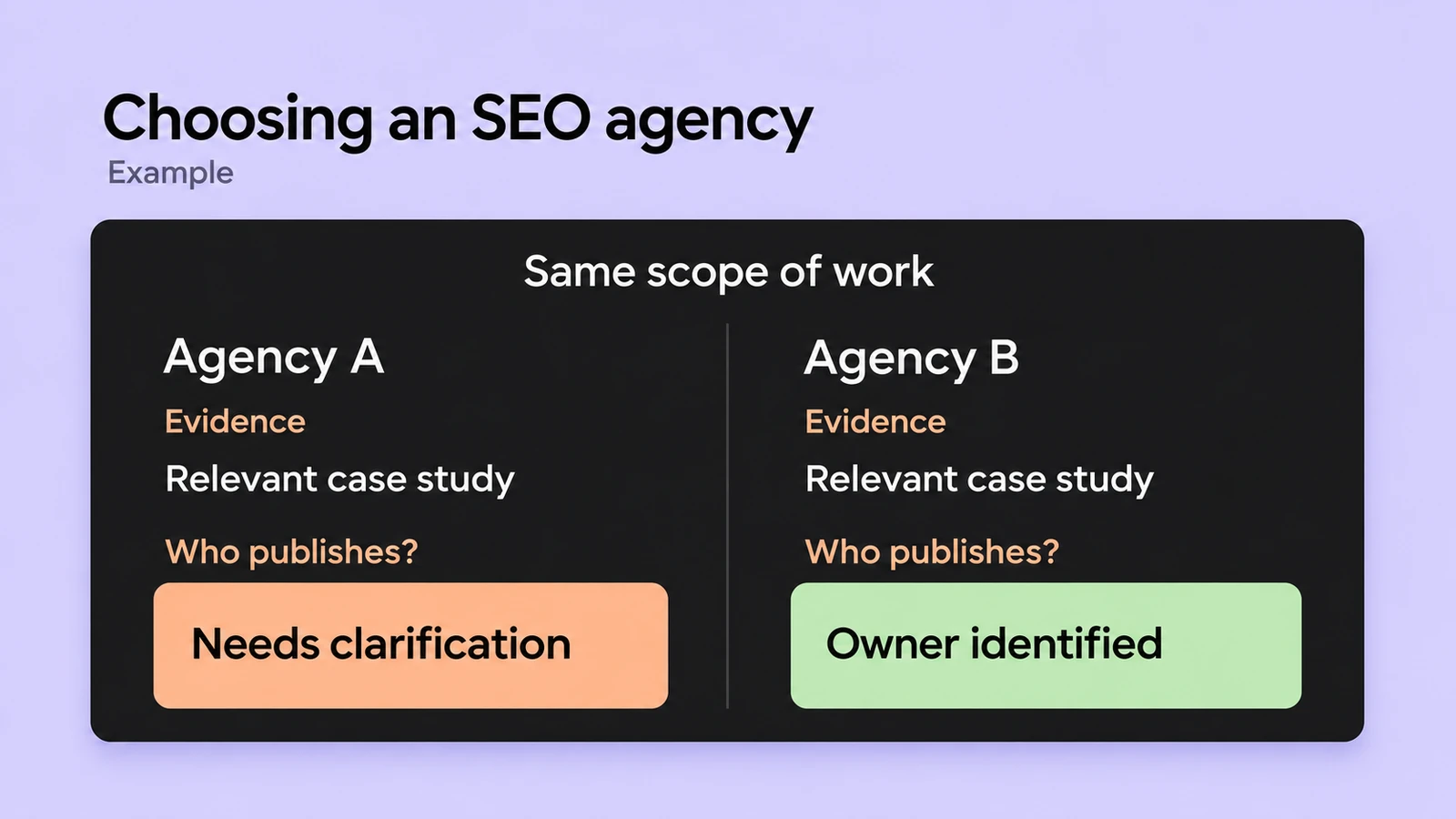
Suppose A presents a relevant industrial case study and includes copywriting, but leaves all website changes to your developer without checking availability. B's case study is from a different industry with a similar service-page problem. B names the writer and developer and specifies which changes are included. Both show a clear report. These responses are also illustrative.
Mark A as “needs follow-up” and ask for a plan your developer can confirm. B can be “suitable” if the proposal covers the necessary changes and the total cost fits your budget. If A confirms a workable solution, keep them on your shortlist. If no one can carry out the work, rule them out for this engagement. Experience in your industry cannot make up for an essential task that no one will handle.
When several candidates meet your requirements, compare the differences that affect your team: internal hours needed, wait times for changes, platform expertise, and total cost. Record why you prefer a candidate alongside the evidence. Adding up scores can hide the difference between a necessary capability and a convenience.
Confirm the final scope in writing
Before work begins, have the provider incorporate the agreed clarifications into the final proposal. It should identify included work, exclusions, responsible people, your team's contribution, the first deliverable, and the first review date. Also check the length of the commitment, how extra work is handled, and the handover of accounts, data, and materials when the engagement ends.
You could reply: “We're interested in the proposal. Before we confirm, let's specify who will publish the service pages and check that they work. For development outside the scope, we're waiting for our provider's estimate and availability. Then let's agree on the first deliverable and the data we'll review at the next meeting.”
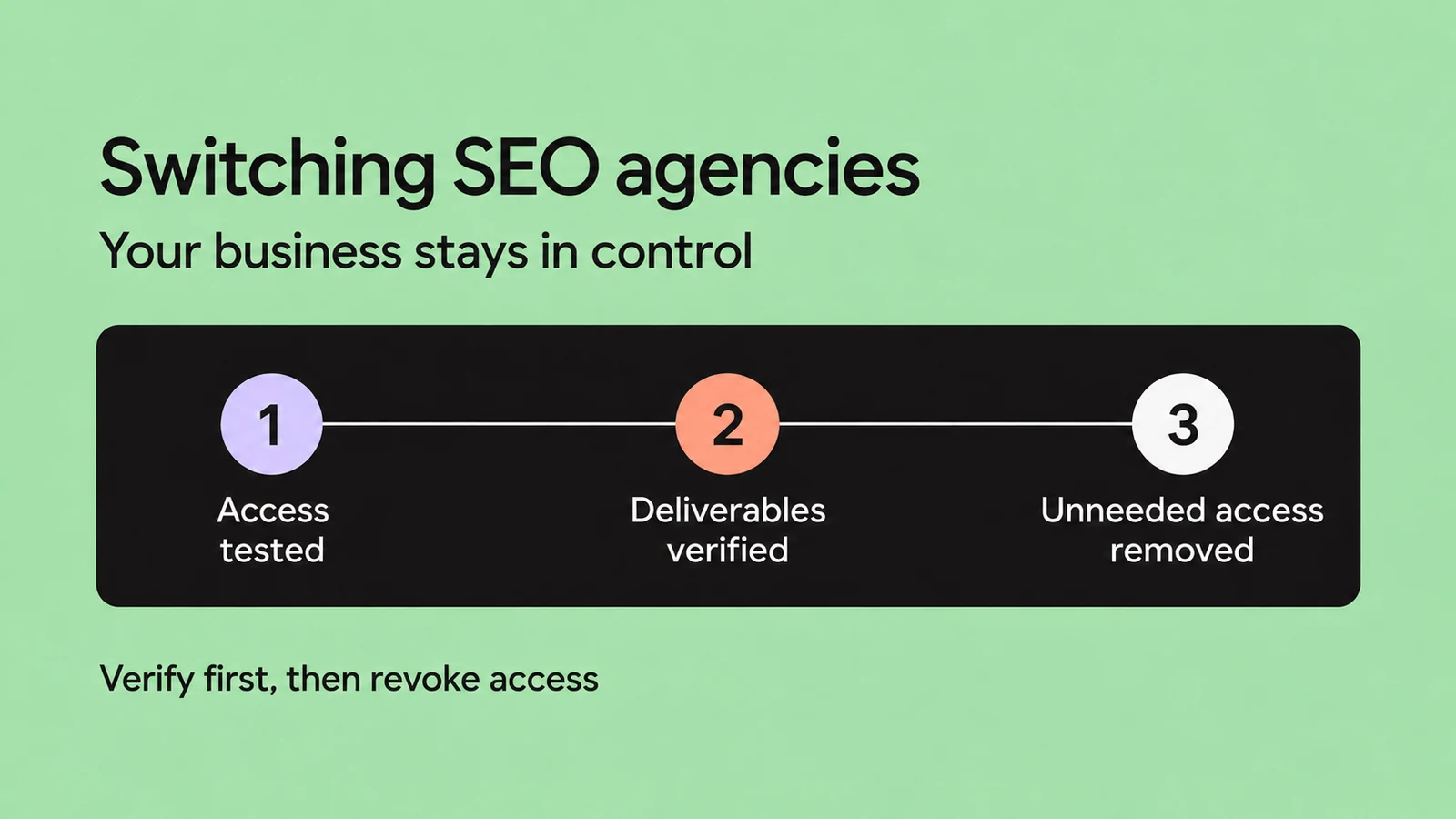
If you have already decided to replace a provider, use the guide to switching SEO agencies to organize access and unfinished work. The new partner's proposal should account for that transition.
Agency location and preliminary audits
Does the SEO agency need to be near my business?
Being nearby can help with site visits, on-site interviews, or frequent meetings with technical staff. If the work happens online, check language, time zone overlap, and how the agency will work with your team. For a local business, ask about experience with searches and customers in your area. A nearby office alone does not establish that expertise.
Should I ask for a free SEO audit before choosing an agency?
You can ask for an initial discussion about your site and an example of a previous deliverable. A detailed audit may be a separate paid project. Before agreeing, define what it will cover, what you will receive, and whether you can have another provider implement the recommendations. A free automated check may flag issues worth investigating, but it does not establish which ones matter most for your project.